Hi everyone,
I have created another activity for my College Algebra course, and I would really appreciate your help reviewing it.
I am posting the link below. This is designed as a classroom activity for my flipped classroom, and my class duration is nearly two hours. I am using cascade to hide each section step by step, but for review purposes, I am revealing all sections.
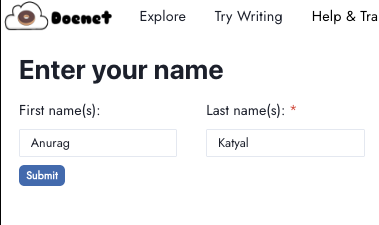
I have also added a “Submitted by” section in the activity because it is difficult for me to assign grades when different names appear from students’ Google accounts. Asking students to enter their names helps me verify their submissions for grading purposes.
Could you please review the activity and share your feedback or suggestions so that I can improve it?
Thank you for your help. I am still hoping to join or find someone through the Test Kitchen, but in the meantime, I would truly appreciate any feedback from this group.
Just as an FYI, you can ask students to change their names on Doenet.
-
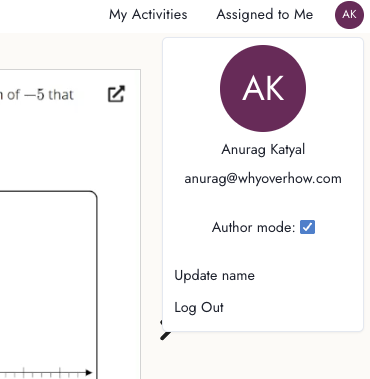
Click on their name in the top right corner of the page.
-
Click on Update name
-
Change their name to whatever it is on your roster.
Thank you. I never know that. So next time I will ask the students to try it and I will check it.
Some thoughts in no particular order…
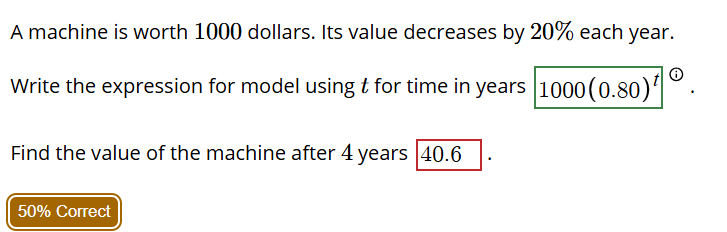
Every problem in Exponential Application Practice uses sectionWideCheckWork. When I entered a wrong starting amount (A_0 = 100 instead of 150) and a correct half-life (h=8), the button reported 25% correct and every field. A student cannot tell which answer is wrong.
“…the increases are getting ___” expects the exact text smaller (type="text" symbolicEquality). Exact string matching fails on “lesser”, “smaller and smaller”, “tinier”, etc. (symbolicEquality might also be meaningless on a text answer.) Making this multiple choice, or accepting some equivalent answers might work better and avoid frustration.
</problem>> - Extra > in line 1029
Line 462 - P in Places is capitalized.
Growth and Decay blocks are asides and not part of a cascade. Students can just skip over them. Neither are required to move on to other parts of the activity.
In the half-life table, every cell answer shares the identical shortDescription “Amount Remaining after the Number of Half-Lives,” so a screen-reader user can’t tell the rows apart. Maybe consider making each shortDescription distinct (“after 1 half-life”, “after 2 half-lives”, …).
If I were being exceptionally silly, I could argue I don’t know what to do with the box at the end of the following questions:
-
Now find the amount of increase
-
To find the new total, we add the increase to the original amount
Perhaps consider changing rephrasing the statements to questions so students know what is expected of them.
I am going to work on all of your suggestions, but I have a question about the first suggestion. You mentioned a section-wide check. Is there a feature like that in Doenet, or did I miss something in the Doenet code that would help me or students to see which part of the question they missed? I am not aware of anything like that. While typing this I searched the documentation then I found something. I want your suggestion here. Can I use forceIndividualAnswerColoring will that work
Try it out and see what happens 
It’s working  . I will change it
Also, maybe the current behavior is good - I don’t know. If one only tests correct answers, this behavior might not have been noticed. It depends on what you, as the author, want to happen when a student enters one incorrect answer, one correct answer and leaves two answers blank (like I did). The grumpy approach (which I am partial to) is to say everything is orange. The admittedly nicer approach would be to tell students which one is correct and which is incorrect. All this is up to you as the instructor/author and how your students react to these sorts of things in/out of class. I don’t think there is a suggestion in what I wrote. My intention was merely to point out something that stood out to me.
I am going to use this with my Summer Algebra 2 kids this week. I love how, when answering some questions correctly, you get a new question to answer. In the growth section, Question 3, “Now find the amount of increase,” maybe add after one year. I am thinking of my high school on-level students, and I am thinking they may stumble for a minute there.
Great activity. You put a lot of work into this
My students really liked the activity. they thought it was a bit long. There were a couple of times students were marked incorrect for not simplifying y=200(1+.06)^t, which I understand we may want a simplified form. However when, answering the question P=1000, r=.06, n=12 and t=5, the answer 1000(1+.06/12)^60 was accepted while the simplified 1000(.0883)^60 was not. This lead to some confusion.
An answer of 24,000 was marked incorrect versus 24000 because of the comma.
The value of e needs three decimal places so you may want to mention that.
These are small things I saw, but it did not take away from the engagement and learning that took place.
Some inconsistencies with equation writing A= versus y= (see Decay problem 5)
Took them about 90 minutes (high school algebra 2).
Hi Nick
I paraphrased the sentences to make them clearer and more specific. I had already specified in the description that students must round to three decimal places, and they can see this when they click on it. Similarly, for the practice problem, I mentioned that students must round to the nearest hundredth, but I have now bolded it to make it more noticeable.
The next thing is that I do not want them to fully simplify their answers. I mentioned in the short description that they should simplify only enough to directly apply the formula, but they do not need to complete all simplification steps. I am doing this so students focus on applying the problem instead of using AI to directly enter the final answer. Also now the answer will accept 24,000 and 24000
Also, I have started using A = only for compound interest problems. Before that question, I had already mentioned that students must use y =, but I have now added a description to that question as well.
I am happy that you are able to use the activity in your class and that you find it useful. I am going to post another activity on logarithms, and I would appreciate your feedback on that one as well.
Thank you Anurag. All feedback has been reviewed, accepted, and addressed. I also changed the activity so that the Decay aside will remain hidden until the student finishes the Growth aside.
Thank you, Anurag and Nick. I have accepted all the review feedback, and the updated link is given below.
Thank you so much for spending 45 to 50 minutes providing me with feedback.
Aishwarya,
This looks great. Here are some minor comments:
First section, #8. I typed 200(1+.06)^t and got it wrong because I didn’t include “y=”. Perhaps you could include the y= before the answer blank, or specify the form in the question. You may also want to hint toward function notation. Instead of calling it ‘y’, it could be f(t).
Car #2, perhaps also accept -0.15 as correct, #3 it wasn’t clear to me what ‘decay factor’ meant. My guess was -0.15 was the decay factor. Perhaps just go directly to the model equation
Radioactive decay (and initial problem). I’m a bit nervous about fractional atoms and fractional people. Perhaps use grams of radioactive material instead of atoms, or change the initial amount so that the answers are never fractions.
Chart for radioactive decay after #8 and slider bars. I really like this. Perhaps the time is represented as the multiplication and the total. 25=10 instead of 25. I would also avoid *, and use (2)(5) or 2 \cdot 5.
The graph is also great. I would have a point on the graph that moves when the slider bar does.
Again, I think this is a great activity.
Side note: My personal point of view. At the introductory level (9th grade Algebra), I like the base being 1.06, 1/2 etc. By the time you get to logarithms (11th grade Algebra / College Algebra), I prefer all models to be A = Pe^(rt) so that you can use natural logs to solve. If you get to the point where students will be answering questions like “How long will it take before the amount of radioactive material is less than 3% of the initial amount?” there will need to be some instruction (like another activity) that gets students to a form where they can use their calculator log buttons to solve.
Just noticed that in the previous post, the multiplication stars didn’t render. I am talking about 2 times 5, which is 2 star 5, which could be written as (2)(5).